 EN
EN
 FR
FR
 JA
JA
 RU
RU
 ES
ES

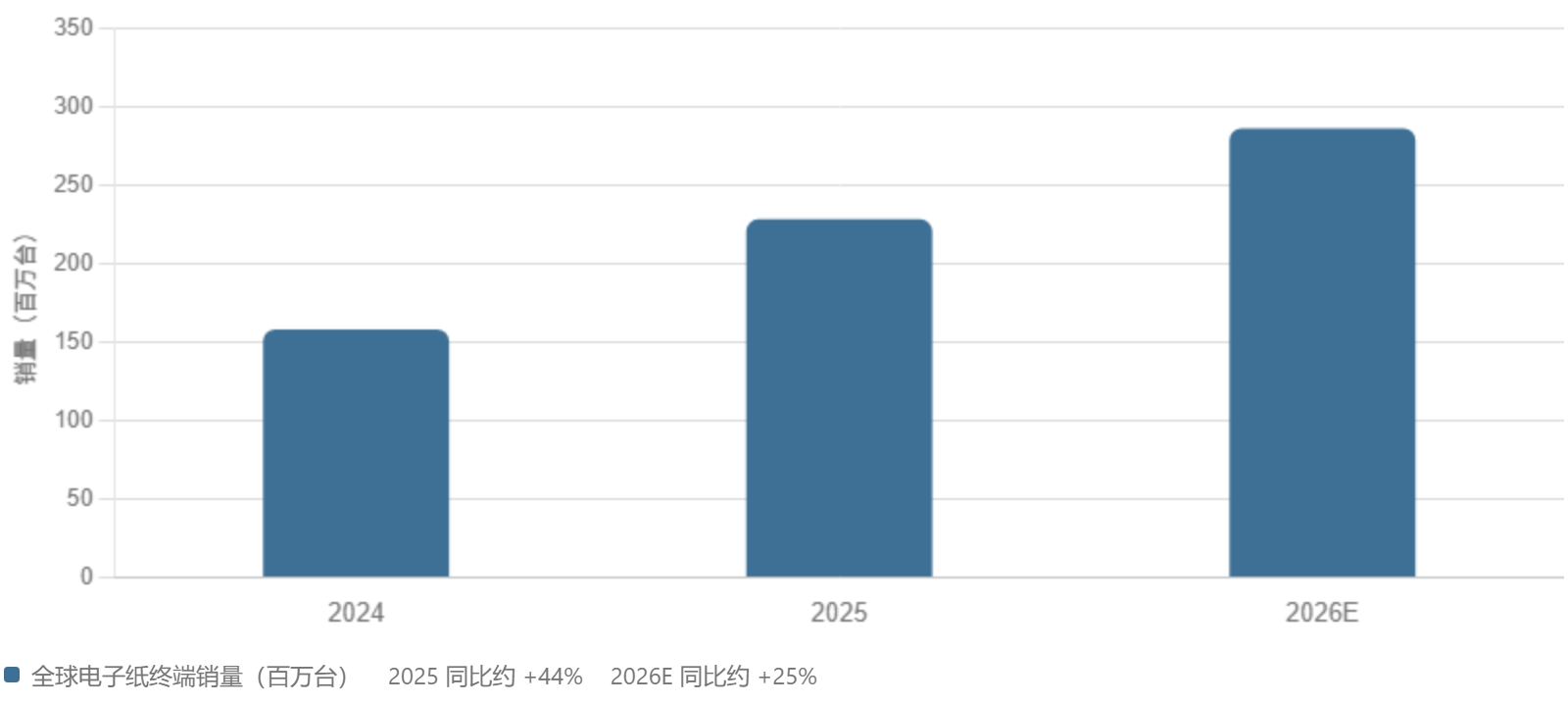
Global device sales rose by 25 per cent year-on-year, with price tags driving the majority of the growth
Data from CINNO • ePaper Insight shows that in the first half of 2026, total global sales of e-paper devices stood at approximately 290 million units, up from 230 million units in the first half of 2025 and 160 million units in the first half of 2024. In terms of year-on-year growth, the rate stood at 44.1 per cent in the first half of 2025 and 25.1 per cent in the first half of 2026; whilst the industry continues to expand, the growth rate has slowed compared with the same period of the previous year.
By application, sales of e-paper price tags stood at approximately 280 million units in the first half of 2026, whilst sales of e-paper tablets reached 6.1 million units; in terms of growth composition, e-paper price tags remain the dominant segment.
The e-paper price tag market continues to expand, with sales reaching 280 million units in 1H’26
In the first half of 2026, global end-user sales of e-paper price tags reached 280 million units, representing a year-on-year increase of 26.8 per cent; in the first half of 2025, sales stood at 220 million units, up 43.8 per cent year-on-year. With sales having risen consecutively in the first halves of the past three years, this demonstrates that smart retail remains the most reliable growth driver for the e-paper industry.
The ongoing digital transformation of retail outlets remains the core driver of growth in the price tag market. New store roll-outs and the refurbishment of existing outlets by large retail chains are generating stable demand, whilst equipment upgrades in the European market are also contributing to industry growth. As multi-colour e-paper price tag solutions mature, product applications are expanding from price display to promotional information, stock alerts and in-store operational management.
From an industry trend perspective, e-paper price tags offer advantages such as low power consumption, the ability to update remotely in bulk, and reduced labour costs associated with manual label replacement; they therefore retain strong momentum for market penetration, driven by retailers’ need to cut costs and improve efficiency. It is anticipated that the price tag market will maintain a certain level of growth in the second half of the year as large-scale projects continue to be delivered.
The e-paper tablet market saw a year-on-year decline, whilst office notebooks maintained growth
In the first half of 2026, global e-paper tablet sales stood at 6.1 million units, a year-on-year decrease of 16.4 per cent; in the first half of 2025, sales were 7.3 million units, a year-on-year increase of 49.0 per cent; and in the first half of 2024, sales were 4.9 million units. Following rapid growth in the first half of 2025, the market has entered a period of adjustment.
By product category, sales of e-paper e-readers stood at 4.8 million units in the first half of 2026, representing a year-on-year decline of 21.3 per cent; in terms of sales volume, they remain the mainstay of the tablet market. Sales of e-paper business notebooks reached 1.3 million units, up 18.2 per cent year-on-year, continuing their growth trend.
The decline in the e-reader market was primarily due to a high base in the same period of the previous year and a temporary weakening of consumer demand; e-notebooks, however, demonstrated greater growth resilience, benefiting from demand in scenarios such as business meetings, handwritten annotations and mobile working. With continuous upgrades in colour displays, slim and lightweight designs, and handwriting functions, the tablet market still has the foundations for recovery.
In terms of product mix, e-readers accounted for approximately 78.7 per cent of e-paper tablet sales in the first half of 2026, whilst the share of business notebooks rose to 21.3 per cent. The market’s growth drivers are gradually shifting from a single reading scenario towards office applications.