 EN
EN
 FR
FR
 JA
JA
 RU
RU
 ES
ES
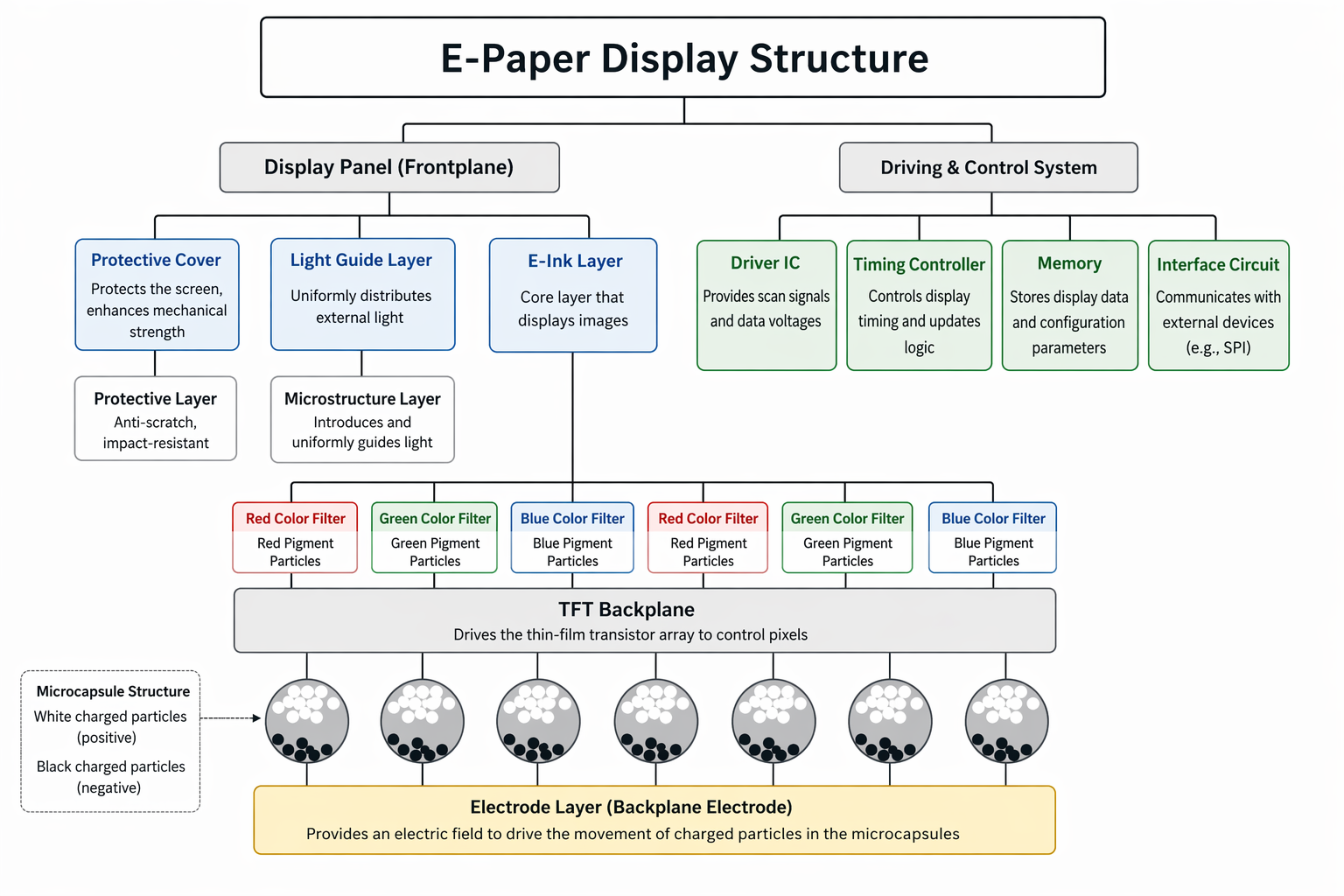
Many people, upon hearing the term ‘e-ink label’, may wonder whether it actually contains ink,today you will learn that e-ink labels do not contain ink.
In this article, you will learn more about e-ink screens.
Definitions and Principles
E-ink screens, also known as e-paper, produce a display that closely resembles natural paper. There are various technologies used to create e-paper, including electrophoretic displays (EPD), electro-wetting displays (EFD), cholesteric liquid crystal displays (CH-LCD) and plasma displays (DES)...
Electronic paper is a type of display technology that forms images by reflecting ambient light and exhibits bistable properties; its core principles are based on technologies such as electrophoresis, cholesteric liquid crystals and electro-wetting, of which electrophoretic display (EPD) is the most mature.
Key Features of E-paper
(1)Bistable: Consumes virtually no power during static display, using only a small amount of energy when refreshing the screen, and retains the displayed content even after power is cut off.
(2) Reflective display: Relies on ambient light reflection to form an image; emits no blue light; offers a visual experience similar to paper; provides good visibility in sunlight; and has a viewing angle of nearly 180°.
(3) Lightweight, thin and flexible: Utilises plastic or flexible substrates, with a thickness as thin as 0.1 mm; can be bent and folded, making it suitable for wearable and in-vehicle applications.
(4) Low power consumption: Energy consumption is significantly lower than that of traditional LCD/OLED screens; suitable for battery-powered devices, with a battery life of up to several months, far exceeding that of traditional display products; this not only saves energy and reduces consumption but also significantly lowers operational and maintenance costs.
(5) Paper-like appearance and eye protection: Requires no self-illumination and produces no blue light interference; the display becomes clearer in brighter sunlight, and viewing for extended periods causes no eye strain, meeting the natural requirements of reading.
(6) Durable and easy to maintain: Utilises e-ink technology, making it lightweight, impact-resistant and capable of remote content updates without the need for on-site intervention, making it suitable for long-term use across multiple scenarios.
Mainstream Technology Pathways
(1) Electrophoretic Display (EPD): Led by E Ink, this technology encapsulates charged particles within microcapsules or microcups and uses an electric field to control particle movement, enabling black-and-white, trichromatic or full-colour displays. It is a mature technology with the widest range of applications.
(2) Cholesteric Liquid Crystal (Ch-LCD): Bistable, requires no polarising film,offers fast response times, and is suitable for outdoor and flexible applications,the process of localisation is accelerating.
(3) Electro-wetting (EWD): Features a wide colour gamut and fast response times, making it suitable for video applications,it is currently in mass production.
Application Scenarios
(1) Retail: Electronic shelf labels (ESLs) enable real-time updates of price and stock information, enhancing retail efficiency.
(2) Education/Office: E-paper tablets and digital notebooks support note-taking, annotations and meeting minutes, whilst AI features enhance the interactive experience.
(3) Reading: E-readers offer a paper-like reading experience, with colour e-paper becoming increasingly widespread.
(4) Internet of Things (IoT): E-tags, smart shelves, transport signage and medical devices utilise low-power characteristics to suit IoT terminals.
(5) Automotive/Outdoor: Flexible e-paper is used for vehicle body decoration, rear-view mirrors and outdoor signage, offering outstanding weather resistance.
Technical Challenges and Trends
Challenges: Low refresh rates (traditionally <1 Hz), high costs associated with colourisation, room for improvement in mass production yield rates, and reliance on imported high-end driver chips.
Trends: Colourisation, high refresh rates, flexibility and larger screen sizes are the primary directions of development. By 2025, the penetration rate of colour e-paper is expected to exceed 50%, refresh rates are set to rise to 60 Hz, and the mass production of large-sized colour e-paper will accelerate.
Thanks to its paper-like feel, low power consumption and eye-friendly properties, e-paper technology is expanding from the reading sector into diverse scenarios such as smart retail, office environments and the Internet of Things (IoT), becoming a key direction for green, low-carbon display technology.