 EN
EN
 FR
FR
 JA
JA
 RU
RU
 ES
ES
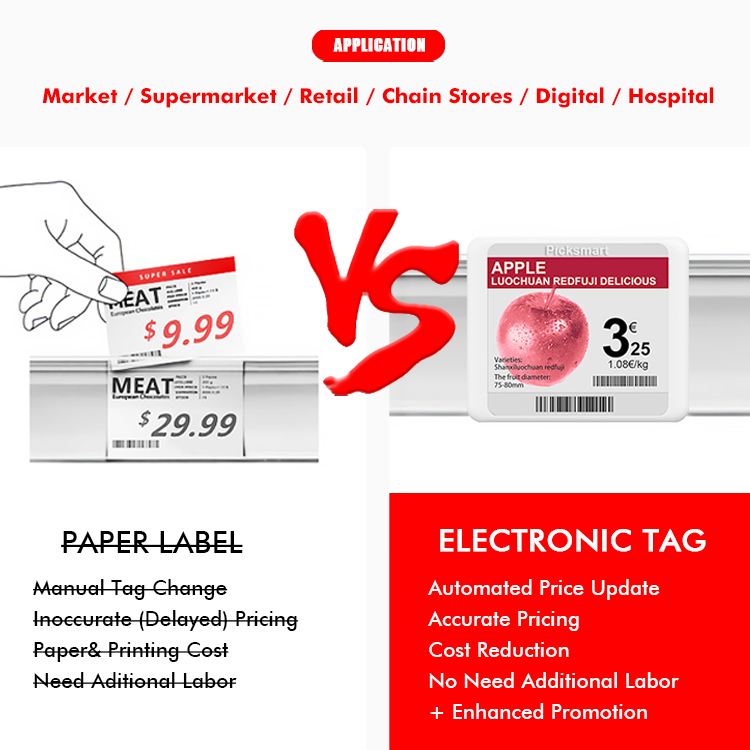
In today’s fast-paced retail environment, pricing accuracy and operational efficiency are more important than ever. While traditional paper price tags have been used for decades, many retailers are now shifting toward Electronic Shelf Labels (ESL) to improve store management and customer experience.
But how do electronic shelf labels compare to traditional paper labels? And which one is the better choice for modern retail businesses?
What Are Electronic Shelf Labels?
Electronic Shelf Labels (ESL) are digital display devices, typically using E-Ink technology, that replace traditional paper price tags. They are connected to a central system, allowing retailers to update product information such as price, promotions, and barcodes electronically.
What Are Traditional Paper Labels?
Paper price tags are manually printed and placed on shelves to display product information. While they are simple and low-cost upfront, they require manual updates and frequent replacement.
Key Differences Between ESL and Paper Labels
1. Price Update Efficiency
Paper Labels:
Updating prices requires staff to print new labels, walk through the store, and replace each tag manually. This process is time-consuming and prone to errors.
Electronic Shelf Labels:
Prices can be updated across the entire store in seconds through a centralized system. No manual replacement is needed.
2. Accuracy and Error Reduction
Paper Labels:
Manual updates often lead to mismatches between shelf prices and checkout prices, which can cause customer complaints and compliance issues.
Electronic Shelf Labels:
Centralized control ensures that all prices are synchronized automatically, minimizing human error.
3. Labor Cost
Paper Labels:
Frequent price changes require continuous staff involvement, increasing labor costs over time.
Electronic Shelf Labels:
Once installed, ESL systems reduce the need for manual price updates, freeing staff to focus on customer service.
4. Flexibility and Promotions
Paper Labels:
Limited flexibility. Promotional updates require reprinting and replacing labels.
Electronic Shelf Labels:
Supports dynamic pricing, flash promotions, and scheduled updates, allowing retailers to react quickly to market changes.
5. Store Appearance
Paper Labels:
Labels can become worn, inconsistent, or misaligned, affecting store presentation.
Electronic Shelf Labels:
Provide a clean, uniform, and modern look across all shelves.
6. Sustainability
Paper Labels:
Require continuous paper usage and disposal, contributing to waste.
Electronic Shelf Labels:
Reusable for years with ultra-low power consumption.
When Should Retailers Choose ESL?
Electronic Shelf Labels are especially beneficial for:
- Supermarkets and grocery stores
- Pharmacies and healthcare retailers
- Electronics and specialty stores
- Retailers with frequent price changes
- Businesses managing a large number of SKUs