 EN
EN
 FR
FR
 JA
JA
 RU
RU
 ES
ES

The explosive growth of the Internet of Things (IoT) has given rise to a diverse range of wireless transmission requirements. Different application scenarios—such as smart devices, smart homes, Industry 4.0 and smart cities—impose varying demands in terms of data rate, power consumption, range and cost, thereby driving the coexistence and complementarity of multiple wireless transmission technologies, including Wi-Fi, Bluetooth, UWB, LoRa, ZigBee and RFID.
In today’s connected world, choosing the right wireless communication technology is critical for building efficient IoT, retail, and warehouse solutions.
From Wi-Fi and Bluetooth to UWB, LoRa, ZigBee, and RFID, each technology offers unique advantages in terms of range, power consumption, speed, and cost.
So, which one is right for your application?
Overview of Wireless Communication Technologies
Different wireless technologies are designed for different purposes. Some focus on high-speed data transmission, while others prioritize low power consumption or long-range connectivity.
Here’s a quick comparison:
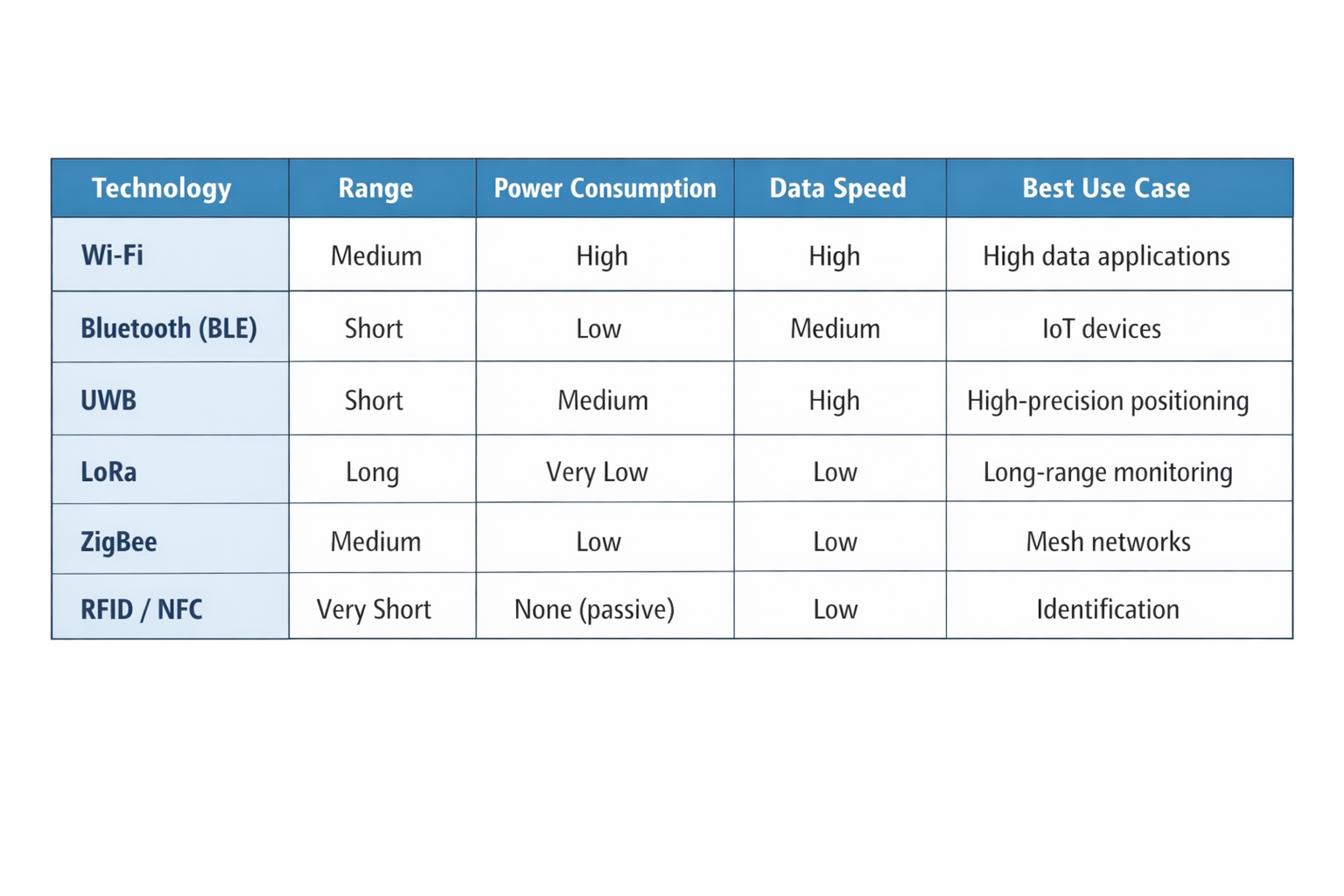
Data rate: Wi-Fi (Gbps) > UWB > Bluetooth > ZigBee > RFID > LoRa (kbps).
Power consumption: Extremely low for LoRa, ZigBee and RFID passive tags; relatively high for Wi-Fi.
Range: LoRa (km) > Wi-Fi/Bluetooth/ZigBee (10–100 m) > UWB (<50 m) > RFID (1–100 m).
Positioning accuracy: UWB (centimetre-level) > Bluetooth/Wi-Fi (metre-level) > LoRa (coarse positioning).
Wi-Fi: High Speed, High Power
Wi-Fi is one of the most widely used wireless communication technologies, known for its high data transfer speed and strong connectivity.
Key features:high bandwidth,stable connection,suitable for real-time data
Limitations:high power consumption,limited scalability for battery devices.
Typical applications:smart retail systems,Network infrastructure,video streaming and data-heavy operations
Bluetooth(BLE):Low Power and Flexible
Bluetooth Low Energy is designed for low-power,short-range communication,making it ideal for IoT devices.
Key features:low energy consumption,smartphone connectivity,easy deployment
Typical applications:electronic shelf label(ESL),smart badge,wearable device
BLE is widely used in smart retail and digital labeling solutions.
UWB (Ultra-Wideband): High Precision Positioning
UWB stands out for its centimeter-level positioning accuracy, making it ideal for real-time location tracking.
Key features:extremely accurate positioning,low latency
Limitations:higher cost,short range
Typical applications:asset tracking in warehouse,industrial positioning systems
LoRa: Long Range, Low Power
LoRa (Long Range) is designed for long-distance communication with minimal power consumption.
Key features:long-range transmission(up to kilometers),ultra-low power consumption
Limitations:low data rate
Typical applications:smart agriculture,environmental monitoring,remote IoT systems
ZigBee: Reliable Mesh Networking
ZigBee is a low-power wireless technology that supports mesh networking, allowing devices to communicate over extended areas.
Key features:mesh network capability,low power usage
Typical applications:smart home systems,lighting control,building automation
RFID and NFC: Battery-Free Identification
RFID and NFC are widely used for identification and tracking, especially in scenarios where battery-free operation is required.
Key features:no battery required(passive tags),fast identification,low cost
Typical applications:asset tracking,inventory management,NFC smart labels
NFC is increasingly used in battery-free electronic labels and smart tags.
Future Trends in Wireless IoT Technologies
The future of wireless communication technologies is moving toward:lower power consumption,higher integration with IoT platforms,smarter retail and warehouse automation,hybrid solutions combining multiple technologies.
Businesses are increasingly adopting multi-technology systems to optimize performance.
Looking for the Right Wireless Solution?
If you're exploring wireless technologies for retail, warehouse, or IoT applications, we can help you find the best solution—from Bluetooth ESL systems to NFC battery-free tags and warehouse automation technologies.
Copyright: All text from internet. For infringement, please comment to inform us.